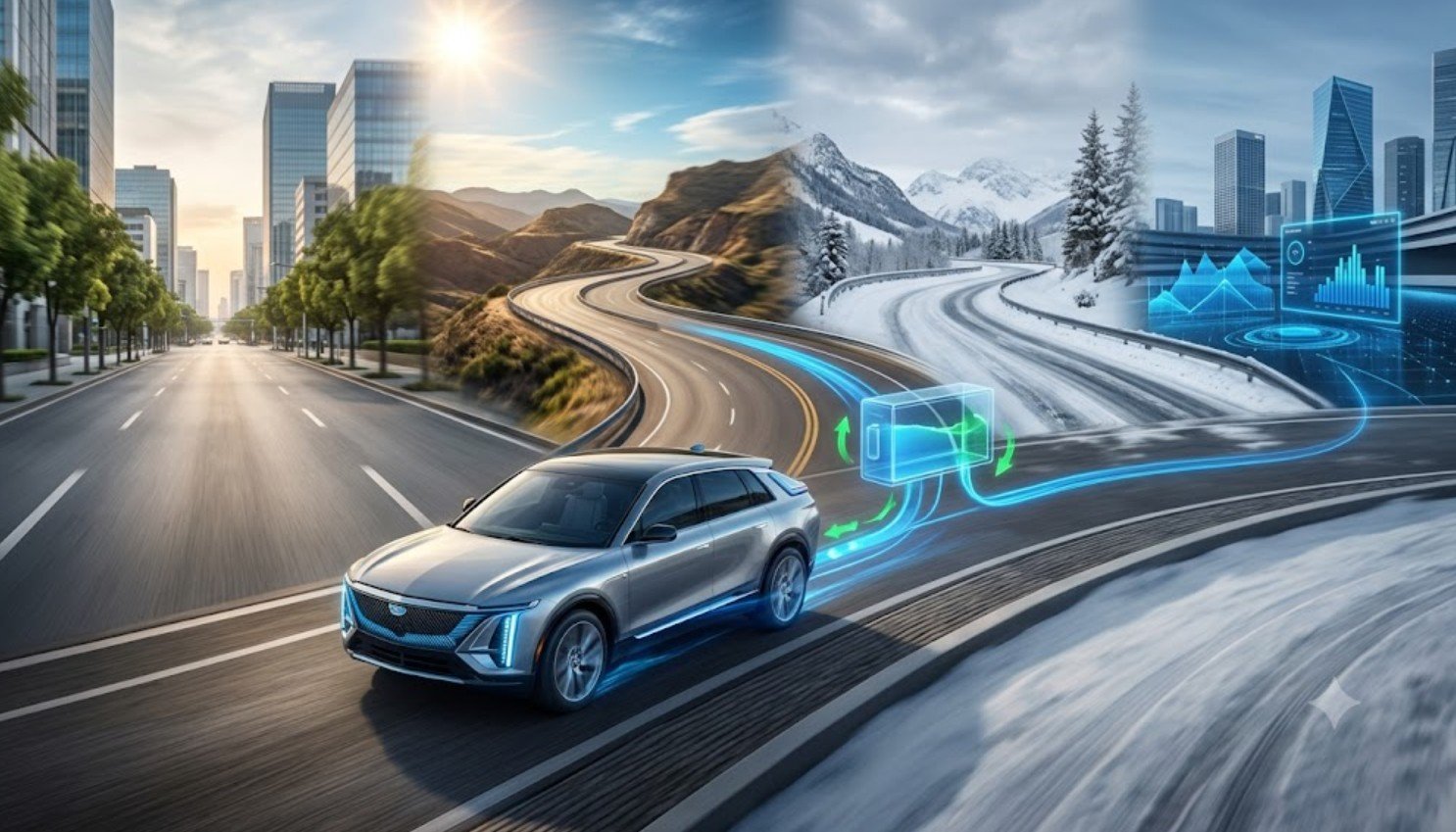
Cadillac LYRIQ drivers can select different modes to change how the electric SUV responds on the road. Tour prioritises smooth everyday driving, Sport sharpens the vehicle’s reactions, Snow/Ice helps manage traction on slippery surfaces, and My Mode allows several driving characteristics to be personalised. Performance-oriented LYRIQ-V models also provide V-specific settings. So, do the driving modes in Cadillac LYRIQ offer different ranges or battery usages? They can affect real-world energy consumption, but Cadillac does not assign a fixed range to each standard mode. The battery capacity remains unchanged. What varies is the way the accelerator, steering, suspension, braking feel, all-wheel-drive system, and other features respond—and how those changes influence the driver’s behaviour.
Do Cadillac LYRIQ Driving Modes Change the Official Range?
Switching from Tour to Sport does not physically increase or reduce the amount of electricity stored in the battery. Cadillac lists a 102-kWh rated battery capacity for the LYRIQ platform. A selected mode changes vehicle behaviour, not the battery’s underlying size.
Cadillac publishes EPA-estimated range figures according to the vehicle’s powertrain and configuration rather than its selected mode. The 2026 rear-wheel-drive LYRIQ offers up to 326 miles of EPA-estimated range, while the available dual-motor all-wheel-drive version offers up to 319 miles. The higher-performance 2026 LYRIQ-V is rated at 285 miles.
These figures should not be read as guaranteed real-world distances. Temperature, road speed, elevation, wind, tyre pressure, vehicle load, climate-control use, and acceleration habits can all change the distance achieved on one charge. Drive modes influence some of those behaviours, but they are only one part of the calculation.
The displayed range is also an estimate rather than a direct measurement of miles remaining. Cadillac says the vehicle calculates it using recent driving habits, current conditions, ambient conditions, and HVAC use. Performance modes, hard acceleration, heavy braking, heated or cooled seats, and battery preconditioning can all affect that estimate.
How Tour, Sport, Snow/Ice, and My Mode Affect Energy Use
Tour Mode is the normal setting for city and motorway driving. Cadillac describes it as providing a balance between comfort and handling with a smooth ride. Its predictable accelerator response makes it the most practical default for relaxed everyday driving.
Tour is not officially described as a dedicated “maximum range” or economy mode. A driver who accelerates aggressively in Tour may consume more electricity than someone who drives smoothly in Sport. However, Tour’s calmer character generally makes consistent and efficient operation easier.
Sport Mode changes accelerator-pedal tuning, steering effort, acceleration response, electric-vehicle sound enhancement, adaptive cruise control behaviour, and suspension tuning when fitted. The sharper pedal response can encourage faster starts and more frequent use of the motors’ available power.
Selecting Sport does not necessarily create a major energy penalty while travelling steadily at the same speed on a flat road. Its effect becomes more noticeable when the driver takes advantage of its quicker response. Cadillac does not publish an official percentage showing that Sport always reduces range by a specific amount.
Snow/Ice Mode adjusts pedal tuning to improve traction on slippery surfaces. On all-wheel-drive models, it also modifies the electric AWD system. Its purpose is safer and more controlled acceleration—not improved efficiency.
Winter range loss should not be attributed to Snow/Ice Mode alone. Cold battery temperatures, cabin heating, winter tyres, snow-covered roads, and increased rolling resistance can have a much larger effect. The 2026 Cadillac LYRIQ owner’s manual explains that cold conditions raise energy use, including the electricity needed to heat the cabin.
My Mode allows the driver to customise available settings such as acceleration feel, brake feel, steering, suspension, and motor sound. The acceleration setting can usually be configured as Relaxed, Tour, or Sport.
My Mode therefore has no single range result. A configuration using Relaxed acceleration may support smoother power delivery, while Sport acceleration can make high energy demand easier. Changes to steering or simulated motor sound are likely to matter far less than speed and accelerator use.
Why Driving Style Matters More Than the Selected Mode
Acceleration requires substantial electrical power, particularly in a heavy luxury SUV with immediate motor torque. Repeated hard launches, rapid overtaking, and frequent speed changes will consume more energy regardless of whether the vehicle is in Tour, Sport, or My Mode.
A driver using Sport gently can achieve better efficiency than someone using Tour aggressively. The mode affects how the vehicle responds to pedal movement, but the driver still determines how much acceleration is requested. Smooth inputs and steady speeds are more important than simply choosing the mode with the calmest name.
Speed is another major factor. As motorway speed rises, aerodynamic resistance increases sharply. Maintaining a high cruising speed can therefore reduce range more noticeably than changing between Tour and Sport while travelling at the same moderate speed.
Climate control also deserves attention. Heating and cooling use energy that could otherwise support propulsion. This becomes especially important in very cold or hot weather. Preconditioning while the LYRIQ is connected to a charger can prepare the cabin and battery using grid electricity rather than relying entirely on the stored charge after departure.
How One-Pedal Driving and Regenerative Braking Affect Range
One-Pedal Driving is separate from the main driving modes. It allows the accelerator to control both acceleration and deceleration. The LYRIQ provides Off, Normal, and High settings, with progressively stronger deceleration when the driver lifts off the pedal.
When conditions permit, the system uses regenerative braking to turn some of the vehicle’s motion back into electrical energy. Cadillac states that One-Pedal Driving can recover more energy while coasting and braking than conventional Drive mode. This can be particularly useful in urban traffic with frequent slowing and stopping.
Regeneration does not recover all the energy previously used to accelerate. Unnecessary acceleration followed by strong regenerative braking is still less efficient than maintaining a steady speed. The most economical approach is to anticipate traffic, accelerate smoothly, and slow gradually.
Regenerative braking may also be limited when the battery is cold or nearly fully charged. Cadillac recommends turning One-Pedal Driving off on slippery roads, where strong deceleration could be unsuitable for the available traction.
How to Maximise and Measure Real-World LYRIQ Range
For predictable everyday efficiency, begin with Tour Mode and use smooth accelerator inputs. Maintain moderate speeds, check tyre pressures, avoid carrying unnecessary weight, and use cabin heating or cooling thoughtfully. When possible, precondition the vehicle while it remains connected to external power.
Do not judge efficiency only by the estimated miles remaining. That number can move up or down as the vehicle learns from recent driving and climate use. Instead, review average energy efficiency over a meaningful distance.
The LYRIQ’s Energy Usage display separates electricity used for driving, remote climate functions, cabin climate control, and fast-charge preparation. Its Energy Efficiency screen also shows recent average efficiency, instant efficiency, and regenerated range.
To compare driving modes fairly, use the same route under similar traffic, temperature, battery charge, and climate settings. Record the energy consumed over several journeys rather than relying on one short trip. Elevation, wind, traffic, and battery temperature can easily distort a single test.
Conclusion
Do the Driving Modes in Cadillac LYRIQ Offer Different Ranges or Battery Usages driving modes can influence battery usage, but they do not provide separate fixed battery capacities or guaranteed range figures. Tour offers a balanced everyday setup, Sport sharpens performance, Snow/Ice prioritises traction, and My Mode reflects the settings selected by the driver.
The largest range differences usually come from how the vehicle is driven. Speed, acceleration, weather, cabin heating, terrain, tyres, and load often matter more than the selected mode itself. For better efficiency, use smooth inputs, take advantage of appropriate regenerative braking, and monitor actual energy consumption through the LYRIQ’s Energy Info screens.
Frequently Asked Questions Do the Driving Modes in Cadillac LYRIQ Offer Different Ranges or Battery Usages
Does Sport Mode reduce Cadillac LYRIQ range?
It can reduce range when its sharper response leads to harder acceleration or faster driving. Cadillac does not publish a fixed Sport Mode range penalty.
Which Cadillac LYRIQ mode is best for battery efficiency?
Tour is the most suitable everyday starting point because it provides smooth, balanced responses. Driving style still has a greater influence on energy use.
Does Snow/Ice Mode consume more battery?
It may alter consumption by changing accelerator and AWD behaviour, but cold temperatures, heating, tyres, and snowy roads usually have a greater effect.
Does One-Pedal Driving extend LYRIQ range?
It can improve urban efficiency by recovering energy during deceleration. However, steady driving remains more efficient than repeatedly accelerating and regenerating.